

Governor Beshear Pushes to Add 16 New Qualifying Conditions
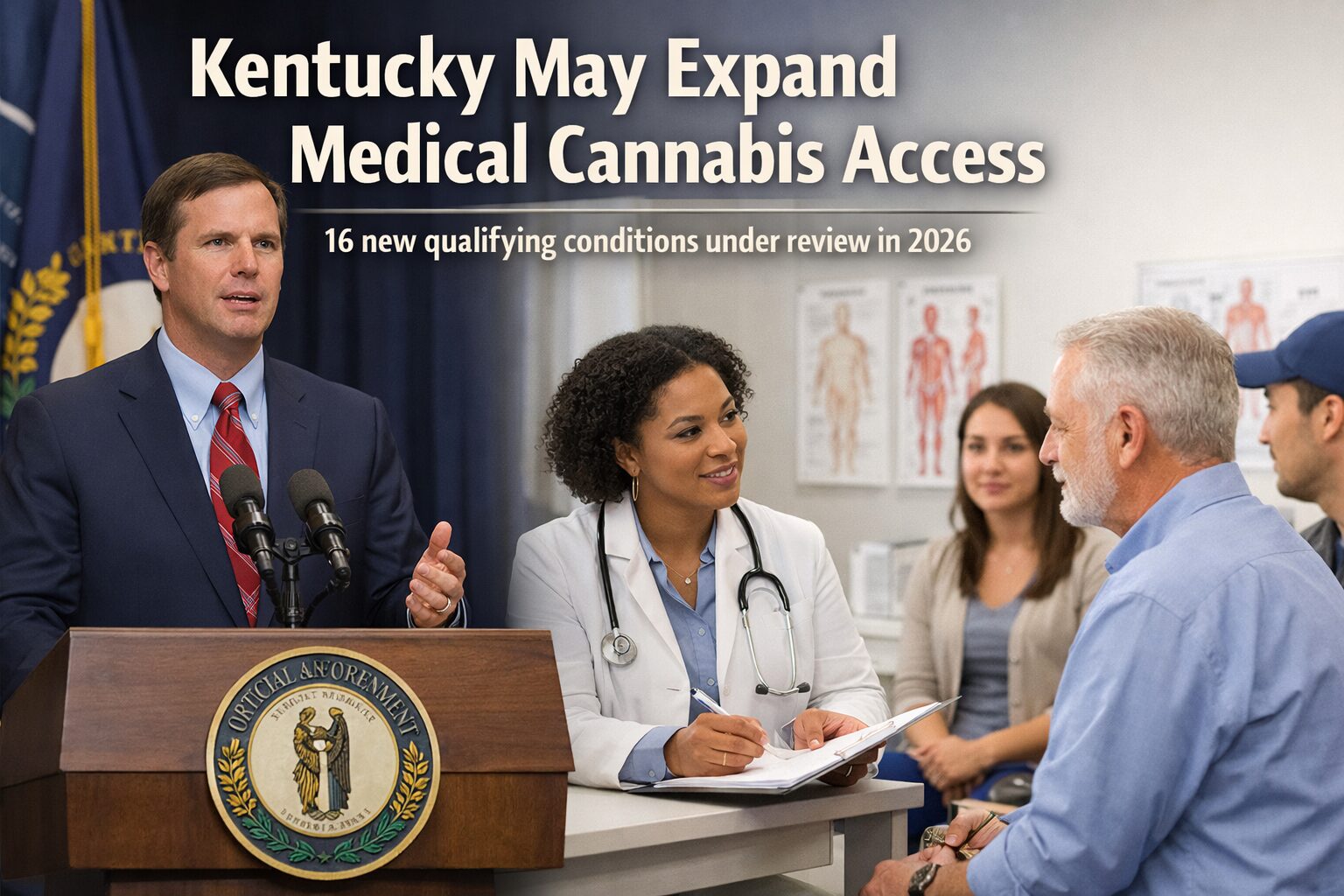
Kentucky may expand its medical cannabis programme to include 16 additional qualifying conditions, such as Crohn’s disease, fibromyalgia, and glaucoma. However, patients do not automatically qualify unless the change is approved by the legislature and they receive a clinician’s written certification.
Kentucky’s medical cannabis eligibility rules may be on the brink of a major expansion, if lawmakers act. In early February 2026, Andy Beshear publicly backed a formal recommendation to add 16 new qualifying conditions to the state’s medical cannabis programme, framing it as a way to bring Kentucky closer to “most other states” and potentially provide relief to a much larger patient population.
For patients, clinicians, and operators alike, this proposal represents more than a policy update, it signals a shift toward broader access and a more inclusive medical framework as the programme matures.
Need a Kentucky Medical Marijuana Card?
If you live in Florida, Georgia, or Kentucky, getting your state-issued medical marijuana card is the first and most important step.
What’s proposed: 16 additional qualifying conditions
The recommendation calls for adding conditions, including (among others) Crohn’s disease, ulcerative colitis, fibromyalgia, glaucoma, neuropathies, arthritis, Parkinson’s disease, ALS, muscular dystrophy, Huntington’s disease, HIV/AIDS, sickle cell anaemia, cachexia/wasting syndrome, and terminal illness. This list has been reported consistently in Kentucky outlets covering the recommendation and the administration’s push.
The pattern across these proposed additions is clear: many fall into chronic inflammatory, neurological, or degenerative categories — areas where other state programmes have already expanded access. That alignment strengthens the argument that Kentucky is moving toward a more standardised national model rather than operating as a limited-access outlier.
How many more Kentuckians could qualify?
The scale is the headline. Kentucky Health News reported the governor’s estimate that expanding eligibility could help provide relief to approximately 430,000 Kentuckians. (Always treat this as an estimate, not a guarantee of individual approval, eligibility still requires a clinician’s assessment and appropriate documentation.)
If realised, that expansion would significantly increase the programme’s potential patient base, with downstream effects on clinic demand, certification workflows, and dispensary volume. For providers, this could mean increased patient intake and a broader mix of conditions requiring ongoing care and monitoring.
Current baseline: the programme still has only six qualifying conditions
Right now, the programme is comparatively narrow. Kentucky’s six qualifying conditions include cancer, chronic/severe pain, epilepsy or other seizure disorders, multiple sclerosis (including muscle spasms/spasticity), chronic nausea/cyclical vomiting syndrome, and PTSD. This “starting list” has been repeatedly summarised in programme explainers and in March 2026 reporting about the proposed additions.
This limited baseline is precisely why the proposed expansion is drawing attention: it represents a potential transition from a highly selective eligibility model to a more clinically representative one that reflects real-world patient needs.
Why the push is happening now
Two forces are colliding:
(1) patients are finally gaining in-state access via dispensaries, and
(2) The state is seeing fast-growing participation in the programme (patient cards climbing above 18,000 by early February and above 20,000 by mid-March, depending on the report date).
As access ramps, pressure grows to align eligibility with patient needs and common medical realities, especially for chronic inflammatory and neurological conditions that are frequently included in other states. There is also a practical consideration: expanding eligibility can help stabilise the programme’s long-term viability by ensuring consistent patient participation and demand across the supply chain.
Need a Kentucky Medical Marijuana Card?
If you live in Florida, Georgia, or Kentucky, getting your state-issued medical marijuana card is the first and most important step.
What has to happen for these conditions to become “official”
This is the most important clarification for anyone following this story: a governor’s recommendation is not the same as enacted eligibility. The recommendation was sent to legislative leadership, and enactment would require legislative action by the Kentucky General Assembly, typically via a bill that amends the relevant medical cannabis statutes or directs the programme to update its list.
As of mid-March 2026 reporting, the issue remained “before the legislature”. That means timelines are uncertain, and outcomes depend on the legislative process, committee reviews, and final bill language.
What patients should do while the list is still pending
If your condition is on the proposed list but not currently qualifying, avoid wasting time and money chasing misinformation. The practical approach is: track legislative movement, gather medical records documenting diagnosis and treatment history, and discuss with an authorised practitioner what, if anything, you can do now under existing eligibility.
If you already qualify under the current six conditions, the proposed expansion may still matter because it could reduce stigma and broaden clinical familiarity with cannabis-based symptom management across specialities. Over time, this can lead to more informed consultations, better treatment alignment, and improved patient outcomes as more practitioners engage with the programme.
What this means for the future of Kentucky’s programme
Beyond immediate eligibility, this proposal signals a broader evolution. Expanding qualifying conditions often leads to increased provider participation, improved patient education, and more diverse product development tailored to specific medical needs.
For patients, that translates into more accessible care pathways. For clinics and operators, it introduces both opportunity and responsibility, scaling services while maintaining compliance and clinical integrity.
If enacted, this change could mark one of the most significant inflection points in Kentucky’s medical cannabis rollout.
Need a Kentucky Medical Marijuana Card?
If you live in Florida, Georgia, or Kentucky, getting your state-issued medical marijuana card is the first and most important step.
FAQ
Thinking about getting your medical cannabis card in Kentucky?
MMJ Health physicians provide compliant evaluations based on Kentucky’s medical cannabis program requirements — with a risk-free process, so you only pay if you qualify.

