

Kentucky Drug Testing Laws & Employee Rights (2025-2026 Guide)
Understanding SB47, employer rights, ADA protections, and what Kentucky’s new medical marijuana laws mean for workers.
The Shifting Landscape: What Kentucky’s New Law Means
With Kentucky’s new medical marijuana program officially rolling out, both employees and employers are asking the same question:
How will this affect workplace drug testing?
While medical cannabis is now legal for qualifying patients, that doesn’t automatically protect workers from being tested or fired for THC use. Employers still have broad authority to require drug tests and enforce drug-free policies.
This blog breaks down Kentucky’s current drug testing laws, how Senate Bill 47 (SB47) affects the workplace, and what both employers and employees need to know moving forward.
Understanding Kentucky Drug Testing Laws
Kentucky does not have a single statewide drug testing law. Instead, employers can create and enforce their own Drug-Free Workplace Programs, as long as their policies are fair and consistently applied.
While participation in a Kentucky Drug-Free Workplace Program is voluntary, it can provide benefits such as reduced workers’ compensation premiums and stronger legal protection if policies are challenged.
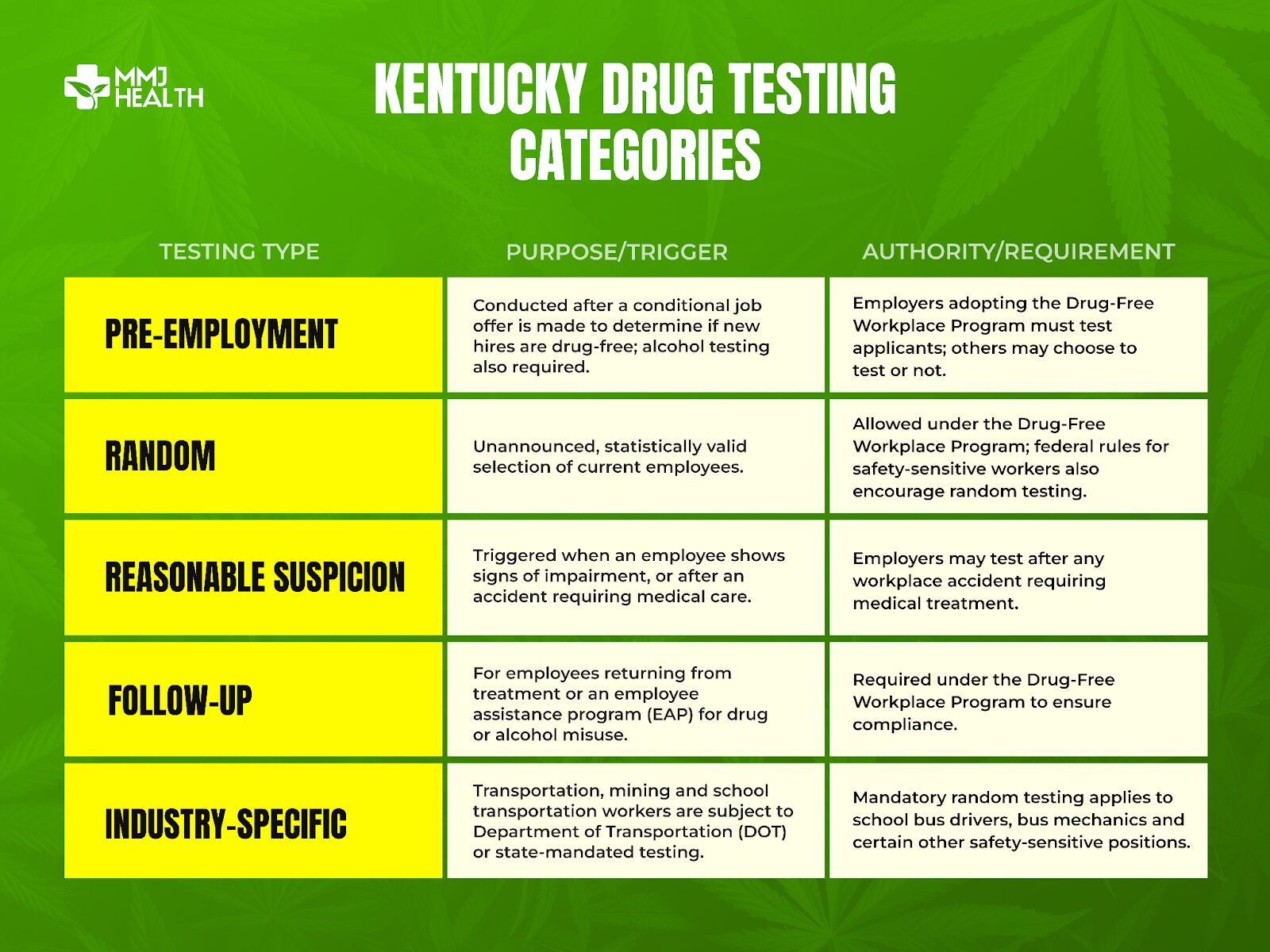
Employers may test employees for drugs or alcohol at several stages of employment, including:
- Pre-employment testing before hiring
- Random testing, particularly for safety-sensitive roles
- Reasonable suspicion testing when impairment is suspected
- Post-accident testing following an incident or injury
Refusing or failing a drug test can result in withdrawal of a job offer or termination. However, if the result is linked to a prescribed medication for a disability (other than cannabis), the Americans with Disabilities Act (ADA) may offer some protection. Employers should always consult a medical review officer (MRO) or legal counsel before disciplining in those cases.
Impact of SB47 on Kentucky Workplace
Senate Bill 47 (SB47) legalized medical marijuana for patients with conditions such as chronic pain, PTSD, cancer, epilepsy, and multiple sclerosis. These patients can now apply for MMJ cards through the Kentucky Center for Cannabis.
However, SB47 does not require employers to accommodate cannabis use. That means even if you have a valid MMJ card in Kentucky, your employer can still enforce drug-free policies.
SB47 does not limit an employer’s ability to:
- Maintain a Drug-Free Workplace Program and enforce zero-tolerance policies
- Conduct random, post-accident, and reasonable suspicion testing
- Discipline or terminate employees who test positive for THC, even if they are registered medical marijuana patients
- Prohibit and cannabis use or possession at work
Bottom line: SB47 protects your right to access medical marijuana but not your right to use it at work.
Unsure if your Kentucky MMJ card protects you at work? Our board-certified doctors can guide you on SB47 compliance and ADA rights.”
👉 Book Your Consultation for $75
Employer Rights Under Kentucky Law
Employers in Kentucky retain broad authority to maintain safe, drug-free workplaces. SB47 does not limit an employer’s ability to enforce those policies.
Zero-Tolerance Policies
A zero‑tolerance workplace drug policy means that any positive test for illegal substances (including medical cannabis) can lead to termination.
- Pros: Reinforces workplace safety and may qualify for insurance discounts.
- Cons: Can make retention harder and may face scrutiny if inconsistently applied.
Pre-Employment Drug Testing
- Conducted after a conditional job offer.
- Positive or refused tests usually allow withdrawal of the offer.
- If the positive is due to a lawful prescription medication (other than cannabis), the ADA interactive process may apply.
Random & Post‑Accident Drug Testing
- Random testing is allowed for Drug-Free Workplace Program participants. Selections must be statistically valid and unbiased when part of the program.
- Post-accident testing is encouraged whenever a workplace injury requires medical treatment.
Disciplinary Action & Termination
Employees who fail a drug test may be disciplined or terminated. Those fired for violating a company policy may be ineligible for unemployment benefits depending on state law and circumstances. Employers should ensure all actions are consistent and documented.
Employee Protections & Privacy Rights
While Kentucky law favors employer discretion, employees still have privacy and fairness protections under state and federal law.
Informed Consent & Confidentiality
- Employees must be notified of testing policies and generally acknowledge consent before testing.
- Samples must be collected discreetly and processed by certified labs.
- Test results are confidential medical information and can only be shared for employment purposes. Mishandling results can violate ADA privacy rules.
Key takeaway: You must consent, and your results must remain private.
ADA & Reasonable Accommodation
- The Americans with Disabilities Act (ADA) allows drug testing for illegal drugs but protects employees who use prescribed medications other than cannabis.
- Because cannabis remains federally illegal, the ADA does not require employers to accommodate MMJ use.
- If a test shows a prescription medication, employers must engage in an interactive process before deciding discipline.
Industry‑Specific Testing
Certain professions face stricter requirements under state or federal law, including:
- Commercial drivers (CDL holders)
- School bus drivers and mechanics
- Healthcare workers and technicians
- Teachers are not routinely drug tested under state law, but local school policies may require it.
MMJ Health helps Kentucky residents get certified safely and understand workplace policies. Let our doctors review your case.”
👉 Talk to a Certified Cannabis Doctor
Probation & Parole vs. Workplace Testing
Workplace testing is not the same as court-ordered testing. Under Kentucky probation or parole supervision, a first positive drug test is generally treated as a minor violation, often resulting in increased monitoring or treatment. Employers, however, can immediately terminate an employee after one positive test. Workplace testing is a private matter, not a criminal one.
Compliance Tips for Employers in 2025-2026
Kentucky employers should ensure their policies are current and compliant with SB47 and ADA obligations to avoid potential legal issues.
Best practices include:
- Review and update policies. Consult counsel to ensure your drug‑free workplace policy explicitly covers cannabis, explains testing triggers (pre‑employment, random, reasonable suspicion, and post‑accident), and details consequences.
- Train HR and supervisors. Supervisors should know how to recognise signs of impairment and document reasonable suspicion.
- Apply policies consistently. To avoid discrimination claims, use random testing methods that are statistically valid when participating in the Drug-Free Workplace Program and apply discipline uniformly.
- Align with the ADA. Ensure policies distinguish between illegal drug use and lawful prescription drugs. The ADA allows employers to prohibit illegal drug use, but does not require accommodations for medical cannabis, and requires confidentiality and non-discrimination for employees taking lawful prescriptions.
- Provide assistance. Provide employee assistance or return-to-duty programs to encourage rehabilitation.
Best Practices For Employees
Employees also play a key role in compliance. Here’s how to protect yourself:
- Know your company’s policy. Request a copy of the drug‑free workplace policy and understand when you may be tested. Ask whether the company follows the Kentucky Drug‑Free Workplace Program or uses a private policy.
- Protect your privacy. You must acknowledge consent to testing; ensure your sample is collected discreetly and that your medical information remains confidential.
- Disclose when necessary. You are not legally required to disclose a medical cannabis card unless you test positive or safety is at stake. If your medication could cause a positive test, proactively provide documentation during the interactive process.
- Avoid cannabis at work. SB47 does not protect on‑duty use; consuming cannabis or arriving impaired can lead to termination and may affect unemployment benefits.
- Comply with probation rules. If you are on probation or parole, remember that a first positive test is a minor violation but repeated failures or refusal to test are major violations that may lead to revocation.
How MMJ Health Supports Patients in Kentucky
MMJ Health is a board‑certified medical cannabis provider serving Louisville, Lexington, Bowling Green, and other locations in Kentucky. Our mission is to make Kentucky’s new medical cannabis program accessible, affordable, and fully compliant.
Here’s how our process works:
- Check your eligibility.
Use MMJ Health’s free online tool to see if you qualify under SB47 for conditions like chronic pain, PTSD, or epilepsy.
- Book a consultation.
Book a consultation. Meet with a certified cannabis physician through telemedicine or in person. Our $75 evaluations come with a 100% money-back guarantee if you’re not approved. During the appointment, the doctor reviews your medical history and issues a certification if you qualify. They’ll also assist with notarization if required and help with the state’s $25 application fee.
- Receive ongoing support.Once approved, MMJ Health helps you submit your application to the Kentucky Medical Cannabis Program, monitors changing regulations, and provides resources on safe use. Patients can renew annually through telemedicine. Their team also provides guidance to help you understand workplace and ADA rules, without guaranteeing employment protections.
By combining expert care with legal compliance, MMJ Health helps Kentuckians get certified and stay protected.
Ready to apply for your Kentucky medical marijuana card? MMJ Health’s $75 consultation includes certification, notarization, and application support — 100% money-back if not approved.
👉 Get Started with MMJ Health Kentucky →
Frequently Asked Questions (FAQ)
Conclusion
Kentucky’s evolving drug testing laws aim to balance workplace safety with employee fairness. SB47 legalized medical marijuana but does not guarantee job protections for cardholders. Employees maintain privacy under the ADA for lawful prescriptions, not cannabis, while employers retain authority to enforce drug-free policies.
Whether you’re updating your company policy or applying for your first MMJ card, MMJ Health can help you stay informed and compliant.
Ready to apply for your Kentucky MMJ card? https://mmjhealth.com/patient-qualification/
