

Medical Marijuana for Seniors in St. Petersburg, FL: “I Just Want Relief, Not an Experience”
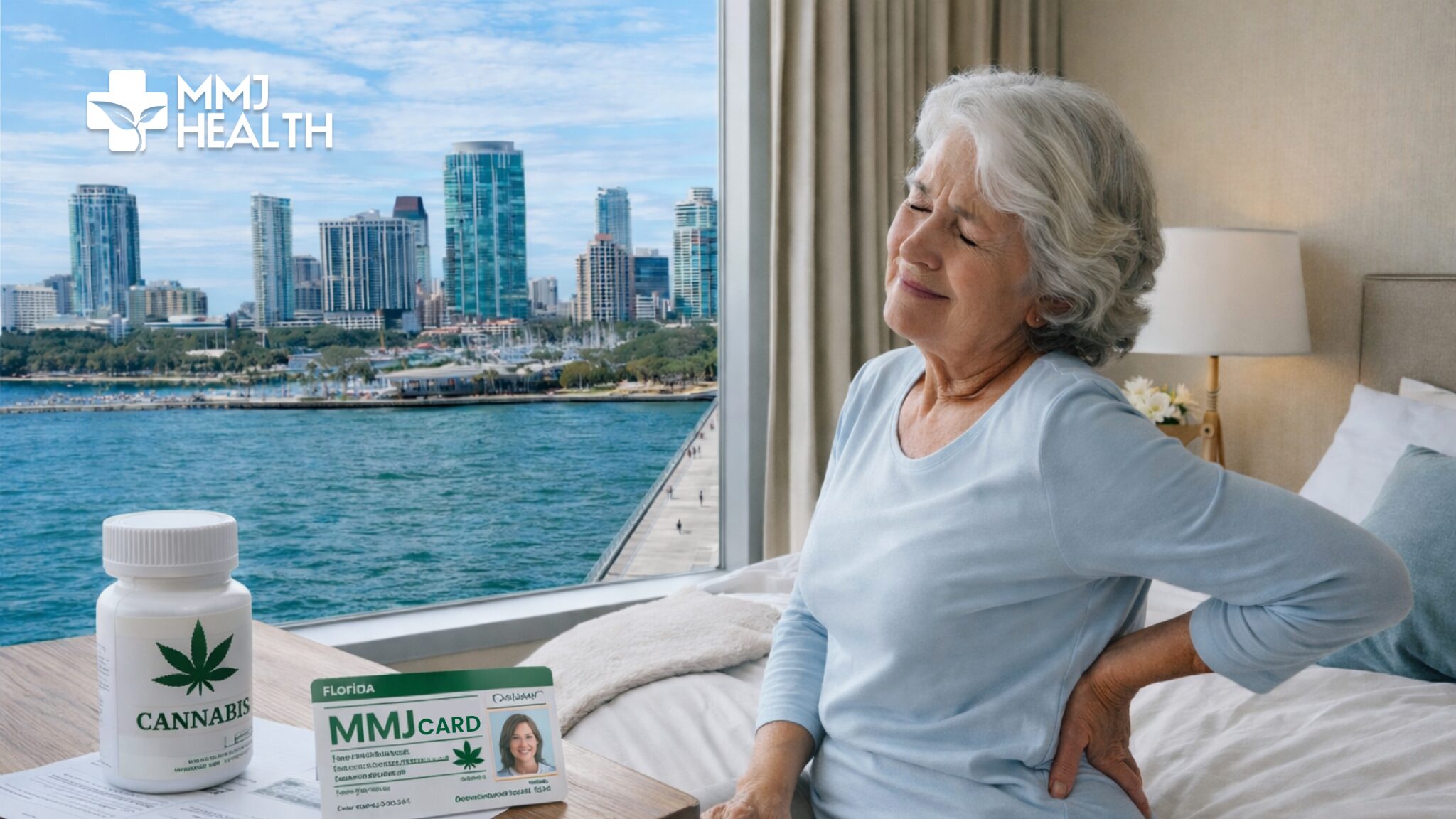
If you’re a senior in St. Petersburg, FL considering medical marijuana for pain, sleep, or anxiety, the biggest fear is usually the same: “I don’t want to feel high.” Florida’s program includes formally defined low-THC options, physician-guided dosing, and a start-low-go-slow approach designed for older patients. A board-certified MMJ evaluation in St. Pete is the safest first step.
For seniors in St. Petersburg, FL, medical marijuana is one of the most common physician referrals for chronic pain, and one of the most feared. The typical reaction when a doctor first brings it up? “I’m 71. I just want relief, not an experience.”
That fear is valid. But it’s also largely addressable. Florida’s regulated medical marijuana program offers low-THC formulations, board-certified physicians who specialize in dosing for older patients, and a structured evaluation process designed around safety.
This guide covers everything St. Pete seniors need to know. Here’s what you’ll find inside:
- Why low-THC options mean you can get relief without getting high
- Which conditions qualify, including arthritis, chronic pain, and insomnia
- How drug interactions with your current medications actually work
- Exactly what the St. Petersburg MMJ card process looks like, step by step
Wondering if you qualify?
Book a same-day MMJ evaluation at our St. Petersburg, FL clinic. Check your eligibility at MMJ Health St. Pete
Key Terms: What Do THC, CBD, and Low-THC Actually Mean?
New to cannabis? These three terms come up throughout this guide. Here’s what each one means:
THC (Tetrahydrocannabinol): The compound in cannabis responsible for the “high.”
Higher THC = stronger psychoactive effect. Physician-guided low doses minimize this significantly.
CBD (Cannabidiol): The non-intoxicating compound in cannabis.
It does not produce a high. Often used for pain, inflammation, and anxiety. Works alongside or independently of THC.
Low-THC Cannabis: A formal legal category in Florida.
Defined by state law as products containing 0.8% or less THC and more than 10% CBD. The most conservative option available through licensed Florida dispensaries.
Will Medical Marijuana Make Me Feel High?
Not necessarily. Whether you experience psychoactive effects depends on the THC content and dose. Florida law defines a formal low-THC cannabis category containing 0.8% or less THC and more than 10% CBD. At physician-guided low doses, many St. Pete seniors report meaningful pain relief and better sleep without significant impairment.
Your certifying physician specifies what’s appropriate for your condition and health history. You don’t choose your own potency off a dispensary shelf.
The principle physicians use for older patients is: start low, go slow. Begin with the smallest therapeutic dose, monitor over several days, and adjust only under physician guidance. For reference, recreational cannabis flower today averages around 20% THC. A physician-guided low-THC tincture for a St. Pete senior patient might start at a fraction of that. The difference in experience is significant.
Why More St. Petersburg Seniors Are Turning to Medical Marijuana
AARP data shows cannabis use among Americans over 50 rose from 12% to 21% between 2018 and 2024. A UC San Diego geriatrics survey found that six out of ten cannabis-using patients started therapy after age 60, primarily for pain, sleep, and anxiety. St. Petersburg’s older adult population reflects this national trend.
Most of these patients aren’t looking for a lifestyle change. They’re managing chronic, compounding conditions that conventional medications haven’t fully addressed, or dealing with medication side effects that are just as disruptive.
In Florida, the Florida medical marijuana card program has grown significantly since Amendment 2 passed in 2016. Over 800,000 patients are currently registered statewide, and older adults in Pinellas County represent a growing share of that population.
How Does Aging Change the Way Cannabis Works in Your Body?
Older adults process cannabis more slowly. Cannabis is fat-soluble, and because body fat increases relative to water as we age, cannabinoids stay in the system longer. Effects can last longer and feel more intense than the same dose would in a younger person. This is why physician-guided dosing matters more for St. Pete seniors than for younger patients.
Stanford Medicine researchers note that slower metabolism in older adults means psychoactive effects can last longer, and that there are more opportunities for interactions with other medications.
Falls risk is another consideration specific to older adults. THC can cause dizziness or unsteadiness. High-CBD, low-THC products reduce this risk significantly. But the right starting point always depends on your individual health profile, which is what a board-certified MMJ physician evaluates.
Aging changes how cannabis works in your body.
MMJ Health St. Pete physicians specialize in dosing for older patients and review your full medication list before recommending anything. Book your St. Petersburg evaluation →
Is Medical Marijuana Safe With My Other Medications?
Drug interactions are the most important safety consideration for older adults on multiple medications. CBD inhibits enzymes that break down certain drugs, which can raise blood levels of blood thinners, anti-seizure medications, and some antidepressants. Always disclose your full medication list to your MMJ physician in St. Pete before starting.
Tell your St. Petersburg MMJ physician if you currently take any of the following:
- Blood thinners (e.g. warfarin) — CBD can raise drug concentration to dangerous levels
- Anti-seizure medications — CBD inhibits the same metabolic pathway these drugs rely on
- Benzodiazepines (e.g. Xanax, Valium) — combining with cannabis amplifies sedation and fall risk
- Opioid pain medications — additive CNS depression effects; dosage may need adjustment
- Antidepressants — interactions vary by drug class; physician review required
- Sleep aids — compounded sedative effects can increase confusion and dizziness
Harvard Health and clinical pharmacology research both identify older adults as especially vulnerable to cannabis drug interactions due to polypharmacy, slower metabolism, and age-related physiological changes. The right response is not to avoid the program. It’s to work with a physician who reviews your full medication history before making any recommendation.
What Conditions Qualify for Medical Marijuana in St. Petersburg, FL?
Florida’s qualifying conditions cover many of the most common health issues affecting older adults. St. Petersburg physicians certified with the state’s OMMU also have broad discretion to certify conditions “of the same kind or class,” which extends eligibility well beyond the core list. If your condition significantly limits daily function, a physician evaluation is the right first step.
Here are the most relevant qualifying conditions for St. Pete seniors:
- Chronic nonmalignant pain — covers arthritis, neuropathy, back pain, post-surgical pain, and musculoskeletal conditions
- Arthritis and osteoarthritis — qualifies under the chronic pain and same-kind-or-class provisions
- Parkinson’s disease — explicitly listed in Florida Statute 381.986
- PTSD — explicitly listed; frequently relevant for older veterans and trauma survivors
- Multiple sclerosis — explicitly listed
- Cancer — explicitly listed; also covers treatment-related symptoms like nausea
- Insomnia — qualifies when symptoms are severe and documented
- Anxiety disorders — qualifies under same-kind-or-class when debilitating and documented
- Fibromyalgia — qualifies under chronic pain provision
- Glaucoma — explicitly listed; relevant for older adults with age-related eye conditions
Florida’s law also allows physicians to certify “terminal conditions” and any condition comparable in severity to those on the primary list. For a full picture, MMJ Health’s Florida qualifying conditions page covers every approved category in plain language.
Low-THC Delivery Options Available at St. Petersburg Dispensaries
| Format | Onset | Best for | Impairment risk | Notes for seniors |
|---|---|---|---|---|
| Tincture | 15–45 min | Pain, anxiety, sleep | Low (at low doses) | Most popular for seniors; easy to measure and adjust |
| Capsule | 1–2 hrs | Consistent daily dosing | Low (at low doses) | Familiar pill format; predictable but slower to adjust |
| Topical cream / patch | 15–45 min | Localised joint or muscle pain | Very low / none | No systemic effect; ideal starting point for impairment-sensitive patients |
| Edible | 1–2 hrs | Sleep, sustained pain relief | Moderate if overdosed | Requires careful dosing; easy to accidentally take too much before first dose kicks in |
| Vape / inhaled | Immediate | Fast acute pain or nausea relief | Moderate | Fast onset but carries respiratory considerations; discuss with physician |
How to Get Your Medical Marijuana Card as a Senior in St. Petersburg, FL
| Step | What happens | Timeline |
|---|---|---|
| 1. In-person physician evaluation | Board-certified MMJ physician at MMJ Health St. Pete reviews your medical history, documents your qualifying condition, and enters you into the state’s Medical Marijuana Use Registry. Same-day card approval available. 100% money-back guarantee. | Same day |
| 2. State application + fee | Complete a short online application with the OMMU and pay the $75 state fee. Patients with a current Florida driver’s licence often receive faster processing via auto-approval. | ~10 business days |
| 3. First dispensary visit | Bring your email confirmation + valid Florida ID to any licensed St. Pete dispensary. Your physician certification specifies which product forms are appropriate. Full process walkthrough here. | Immediately after state approval |
Same-day approval available for qualified patients in St. Petersburg.
100% money-back guarantee. No risk to find out if you qualify. Book your St. Pete MMJ evaluation today
Frequently Asked Questions
Frequently Asked Questions
Yes, in most cases. Arthritis and osteoarthritis frequently qualify under Florida’s chronic nonmalignant pain category or the conditions-of-the-same-kind-or-class provision. A certified physician at MMJ Health’s St. Pete clinic can document the qualifying pathway during an in-person evaluation. Visit the Florida qualifying conditions page for more detail.
Possibly, which is why disclosing all medications to your St. Pete MMJ physician is essential. High-THC products can temporarily raise heart rate and blood pressure. CBD can also interact with certain medications through the cytochrome P450 enzyme pathway. Stanford Medicine researchers recommend that patients with known cardiac conditions also consult their cardiologist before starting.
Florida law formally defines low-THC cannabis as containing 0.8% or less THC and more than 10% CBD by weight. Regular medical cannabis has no such limits. Both are available through St. Petersburg’s licensed dispensaries, and your certifying physician specifies which is appropriate for your condition and sensitivity.
Most St. Pete patients complete the process in two to three weeks from their first in-person evaluation. State approval via the OMMU typically takes around 10 business days, and patients can usually begin purchasing from a licensed St. Petersburg dispensary immediately after receiving their approval email, before the physical card arrives.
It can be safe with careful physician oversight. CBD affects drug metabolism enzymes that process blood thinners and other medications, potentially raising their levels in the bloodstream. Harvard Health recommends a full medication review with a certified cannabis physician before starting. This is standard practice at MMJ Health’s St. Pete evaluation clinic.

